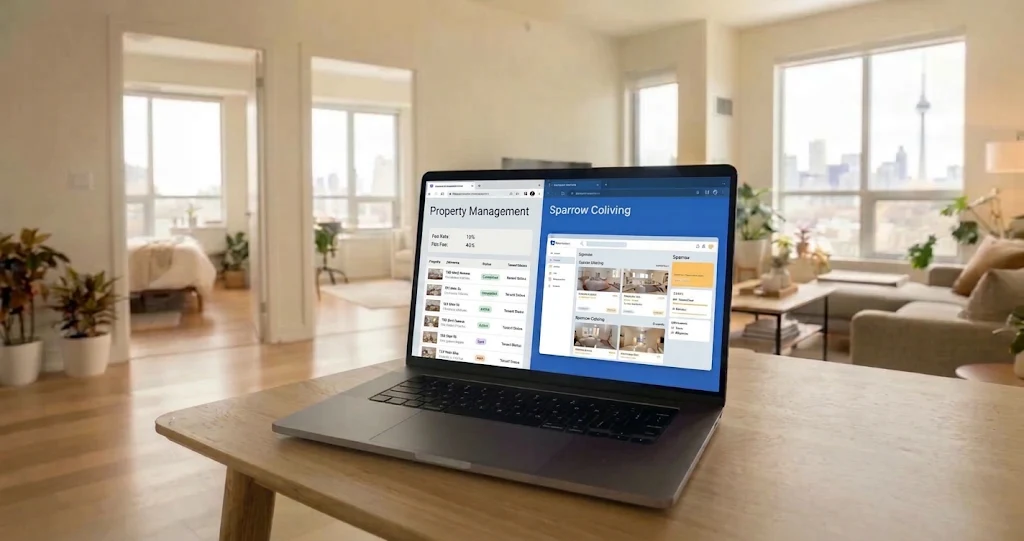
If you own a rental property in Toronto or the GTA, property management fees in Toronto are probably one of the first things you’ll look at when deciding how to manage it. You want someone to handle the day-to-day responsibilities, but you also want to make sure the fees aren’t eating too much into your rental income.
Traditional property management is one option, usually involving renting your entire property to a single household. But there’s another approach worth considering. Co-living property management in Toronto involves renting out individual bedrooms to separate housemates, which can change both how much rental income your property generates and what management involves.
So, how do the two approaches compare when it comes to fees, rental income, and the amount of work you have to handle yourself? Let’s look at what each model costs and what you actually get in return.
How Much Do Traditional Property Management Fees Cost in Toronto?
If you’re considering hiring a property manager for your GTA rental, the monthly management fee is usually the first cost you’ll notice. Industry sources put traditional property management fees in the GTA at roughly 6% to 12% of monthly rent, with most averaging around 8% to 10%. Rates vary by city and property manager, so treat these figures as a general guide rather than fixed prices.
But the monthly fee isn’t always the only cost. Most property managers also charge a separate tenant placement or leasing fee, usually between 50% and 100% of one month’s rent. You pay this each time a new tenant moves in. Some managers also charge smaller fees for lease renewals and periodic inspections. These charges are part of how traditional property management works. You pay an ongoing percentage for day-to-day management, then additional fees when specific tasks come up. If your property has frequent tenant turnover, those placement fees can quickly add up.
That’s why, when comparing property management fees in Toronto, it’s worth looking beyond the advertised monthly percentage. What matters is how much you’ll pay in total and how much rental income you’ll actually keep after management costs.
What Does Sparrow’s Co-Living Management Fee Include?
With traditional property management, you may pay extra when a new tenant moves in or a lease needs renewing. Co-living property management in Toronto works differently. Precisely with Sparrow, you pay a 15% management fee on rent collected, with no separate tenant placement, renewal, or inspection fees.
That fee covers the work involved in renting out individual rooms. This includes furnishing, marketing, tenant screening and matching, leasing paperwork, rent collection, and day-to-day management.
For you as a property owner, this means fewer separate charges to keep track of and a clearer picture of your management costs. When comparing co-living vs. traditional property management, look at what’s included in the fee, not just the percentage. A higher management fee may cover services you’d otherwise pay for separately.
Can Co-Living Generate More Rental Income Than Traditional Renting?
Management fees are only half the picture. If you want to get the most out of your GTA property, you also need to consider how much rental income it could generate and how long it might sit vacant.
With traditional property management, you typically rent your entire property to one household for a single monthly amount. If you struggle to find a tenant, the whole property can remain vacant, leaving you without rental income during that period. Co-living takes a different approach. You rent out individual bedrooms to separate housemates, so you can fill rooms one at a time instead of waiting for one household to take the entire property. This can make it easier to maintain occupancy and reduce the impact of a full-unit vacancy.
Depending on your property’s layout and the local market, renting out individual bedrooms could generate more total rental income than leasing the entire property to one household. However, the difference will depend on how many rooms you can rent, the rent each room can command, occupancy, and the additional costs of managing a shared home.
This is where co-living vs. traditional property management becomes more than a comparison of rental income. Even if co-living management has a higher headline percentage, the additional rental income and fewer separate management charges could leave you with more money overall. The important step is to compare your potential net income after fees, vacancy periods, and operating costs, not just the management percentage.
Management vs. Sublease: How Much Control Do You Keep Over Your Property
Higher rental income is appealing, but you also need to think about how much control you want to keep over your property. Co-living arrangements can work in different ways, so it’s worth understanding the difference before choosing one.
With a management model, you retain ownership and the landlord relationship while Sparrow handles the day-to-day operations. This includes finding housemates, collecting rent, and managing ongoing issues. A sublease model works differently, with Sparrow taking on more responsibility for the rental arrangement.
Traditional property management typically follows one structure where you pay for full management while keeping the landlord relationship. With managed co-living, you have more flexibility in how the arrangement works. The right choice depends on your property, your goals, and how involved you want to be. When comparing property management vs. managed co-living, look beyond potential returns. Consider which arrangement gives you the right balance of control, support, and responsibility.
Would Your Property Be a Good Fit for Co-Living Management
Co-living management isn’t the right fit for every property, so it’s worth checking whether your home suits the model before committing. It generally works best for properties with two or more bedrooms and a layout that allows housemates to have their own private rooms. You’ll also need to be comfortable furnishing or adapting the property for shared living and allowing time to find the right housemates.
If that sounds like your property, your next step should be to look at the numbers. A conversation with Sparrow can help you understand your property’s rental potential and whether co-living makes financial sense for you.
Book a call with Sparrow to discuss your property, explore its potential rental income, and find out whether co-living management is a good fit.
FAQs
Traditional property management in Toronto typically costs 8% to 10% of monthly rent, plus a separate tenant placement fee of 50% to 100% of one month’s rent. Sparrow charges a single 15% fee on rent collected for co-living management. This covers furnishing, marketing, tenant screening, leasing, and day-to-day management.
Traditional property management fees in Toronto generally range from 6% to 12% of monthly rent, with most managers charging around 8% to 10%. You may also pay a tenant placement fee of 50% to 100% of one month’s rent.
Not entirely. Sparrow offers two arrangements. With a management model, you retain ownership and the landlord relationship. With a sublease model, Sparrow takes on more responsibility for the rental arrangement.
Your property’s potential rental income depends on its layout, location, room sizes, and local demand. A conversation with Sparrow can help you assess whether the model makes financial sense for your property.
Properties with two or more bedrooms and a layout that supports private rooms are generally a good starting point. You’ll also need to be open to furnishing or adapting the property for shared living and allowing time to find suitable housemates.



Leave a Comment