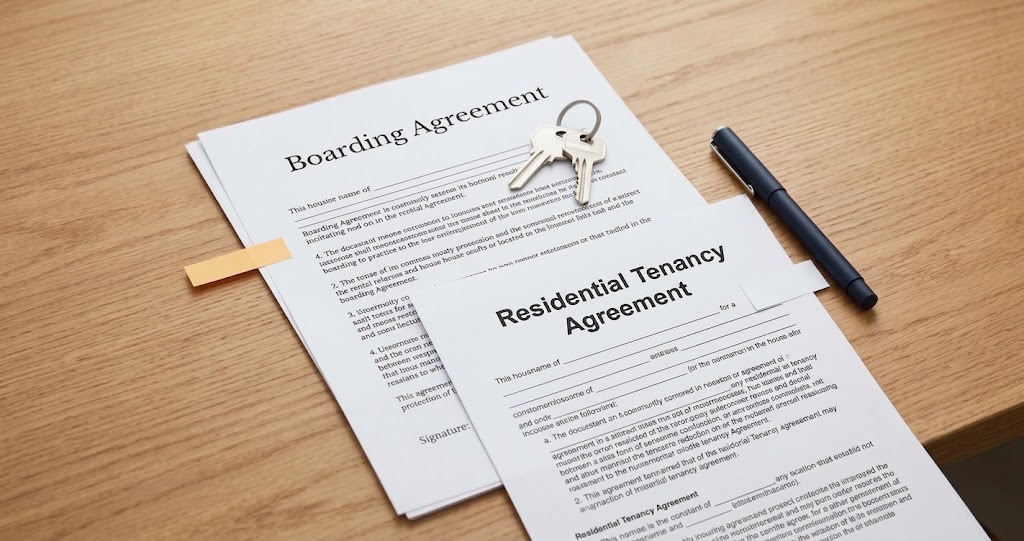
If you’ve found a room for rent in Vancouver, Surrey, Burnaby, or anywhere else in British Columbia, there’s one important thing to figure out before you sign an agreement. Does the homeowner live in the home with you? That detail can make a big difference. It can determine which agreement applies to your living arrangement, including your notice period, your rights, and how disputes are handled. Understanding the rules behind Rental Agreements for British Columbia Rooms is important because they’re shaped by provincial law, whether you’re renting a room in Vancouver, Surrey, Burnaby, or another BC city.
Which Rental Agreement Applies to Your British Columbia Room?
BC’s Residential Tenancy Act does not cover every rental situation. If the person you are renting from lives in the same home and shares kitchen, bathroom, or laundry facilities with you, that arrangement falls outside the RTA entirely. A boarding agreement is the correct instrument instead.
| Boarding Agreement | RTA Agreement | |
|---|---|---|
| When it applies | The Host lives in the same home as the Boarder and shares a kitchen or bathroom with the Boarder. | Shared suites, condos, and apartments where the landlord is off-site |
| Legal framework | Not covered by BC’s Residential Tenancy Act | Full BC RTA protections apply |
| Your notice to leave | Typically 30 days | One month’s written notice, effective the day before rent is due |
| Host or landlord notice to you | Typically 30 days | Three months for own-use termination (updated June 2025) |
| Where disputes go | Through Sparrow support first, with monetary disputes able to proceed to the BC Civil Resolution Tribunal or Provincial Court Small Claims | BC Residential Tenancy Branch |
Neither arrangement is better. They apply to different living situations, and understanding how Rental Agreements for British Columbia rooms work can help you know which one covers you and what to expect before you need it.
What Should Be in Your Rental Agreement?
Whichever type you end up with, the same fundamentals should be spelled out clearly. Pay particular attention to the deposit and lease term sections, where BC rules differ meaningfully from other provinces.
Who is involved. Name both the host or landlord and you, with contact information for each side.
What you are renting. The address, the specific room, and exactly which shared spaces come with it: kitchen, bathroom, laundry, and any common areas.
How long, and starting when. The agreement should state whether the tenancy is fixed-term or month-to-month, with a clear start date. In BC, a fixed-term tenancy agreement cannot require you to vacate at the end of the term unless a specific exception applies, so confirm the terms carefully before signing. Boarding arrangements are typically month-to-month.
Rent and deposit, in plain numbers. The rent, due date, and payment method should all be written down. Under the BC RTA, a security deposit cannot exceed half of one month’s rent, and a pet damage deposit cannot exceed half of one month’s rent either. Neither limit applies to boarding arrangements, where deposit terms are set by the agreement itself.
Utilities. Confirm what your rent covers and what falls on you. Shared homes usually bundle utilities in. Suites and apartments vary more, so check.
House rules. In a boarding arrangement, house rules matter because you share the home with your host. Agree on things like noise, guests, kitchen use, pets, and shared spaces before you move in. In an RTA-covered tenancy, landlords have less flexibility to set lifestyle rules, although terms such as no-smoking clauses may apply if included in the agreement.
Notice to end things. The agreement should state what notice each side owes the other. Under the BC RTA, tenants give one month’s written notice, effective the day before rent is due. Landlord notice varies by reason: for own-use termination, the landlord must give three months’ notice (updated June 2025).
The Terms That Trip People Up
Subletting. Boarding arrangements typically do not allow it, so confirm before signing. Under the BC RTA, you need the landlord’s written consent to sublet. If your fixed-term agreement has six months or more remaining, the landlord cannot unreasonably withhold that consent.
Late fees. A boarding agreement may include a late payment clause. Check the grace period and amount before you sign. Under the BC RTA, late fees are not legal. Any clause trying to charge one in an RTA tenancy simply does not hold.
Entry. Under the BC RTA, your landlord needs to give at least 24 hours’ written notice before entering, except in an emergency. In a boarding arrangement, your host already lives there and has access to shared areas at all times. That is the nature of living in someone’s home, not an entry right over your private room.
Repairs. Most agreements ask you not to make alterations without asking first, and to report maintenance issues in writing as soon as they come up. Under the BC RTA, your landlord must keep the unit in a state of repair that meets applicable health, safety, and housing standards.
Insurance. Some agreements require renter’s insurance. If you are renting through Sparrow, SparrowCare already includes coverage, so check whether that applies to you before you go looking for a separate policy.
Before You Sign
BC draws renters from outside the province and outside Canada in large numbers, both students arriving at the different institutions and also professionals relocating for work. If that is you, the steps below matter more. You are likely committing to a room you have not seen in person.
- Read the whole agreement, not just the parts your host walks you through. If a clause does not make sense, ask about it before you commit, not after.
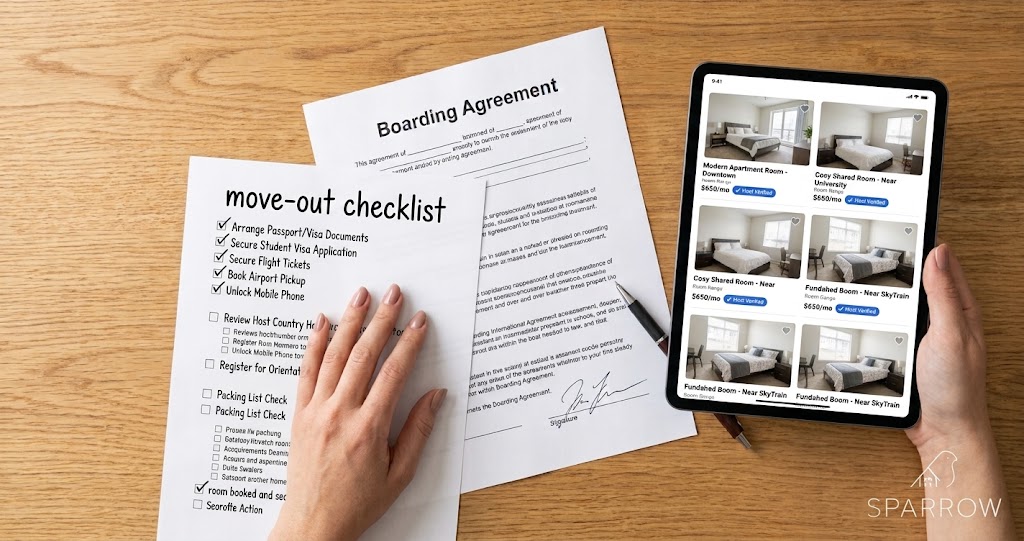
- If you are searching online, verify who you are dealing with before any money moves. Confirm identity through the platform first, and never send a payment before you have a signed agreement in hand.
Still not sure which type applies to your situation? See how Sparrow structures each arrangement before you sign anything. Notice periods, utility inclusions, and house rules in boarding arrangements are often still negotiable.
FAQs
A boarding agreement applies when you share a home with the owner, who lives there too. In BC, this arrangement is excluded from the Residential Tenancy Act when the landlord shares kitchen, bathroom, or laundry facilities with you. That means fewer formal statutory protections, but usually more flexibility and a shorter notice period for everyone involved.
Under a boarding agreement, the notice period is whatever the agreement itself sets, typically 30 days, so confirm the exact figure before signing. Under the BC RTA, tenants give one month’s written notice, effective the day before rent is due. A landlord ending a tenancy for their own use must give three months’ notice (updated June 2025).
Check the rent, which utilities are included, notice periods on both sides, and the deposit amount and conditions. Know the house rules if they apply, and what recourse you have if something goes wrong.
Yes. Sparrow provides the agreement for both homeshare and coliving arrangements across BC, so you are not sourcing your own. It is ready before you move in.
Find a verified room with a trusted host in BC
Looking for City-Specific Guidance?
The legal framework on this page applies province-wide. For local context, neighbourhood prices, transit, and institutions, see the dedicated city guides for Vancouver, Surrey, and Burnaby below:
Room Rental Agreements in Vancouver BC
Room Rental Agreements in Surrey BC
Rental Agreements in Burnaby BC


Leave a Comment